
By CheckeSIMRates · App figures and prices checked 14 November 2026
How much data do you need for travel? For most trips, about 0.5–1 GB a day: that covers maps, messaging, browsing and some social media. Plan on 2 GB a day or more only if you stream video, make long video calls or share your connection with a laptop.
Below we turn the app makers’ own figures into a daily budget, then price that budget with 66,988 travel eSIM plans from 31 providers. These budgets are estimates built from published figures, not measurements of a real trip, so your own phone’s history is the best guide. The short version on price: for a week in most of Europe and Asia, 7 GB typically costs $11–$17 and an unlimited eSIM $22–$27.
Travel data in numbers (November 2026)
- Light use is about 0.5 GB a day, typical use 1 GB, heavy use 2 GB or more. Video is what moves you up a level.
- At home, people use 0.4–0.8 GB a day on average: 22 GB a month per smartphone worldwide (Ericsson, end of 2025) and 11.8 GB in the UK (Ofcom, 2025).
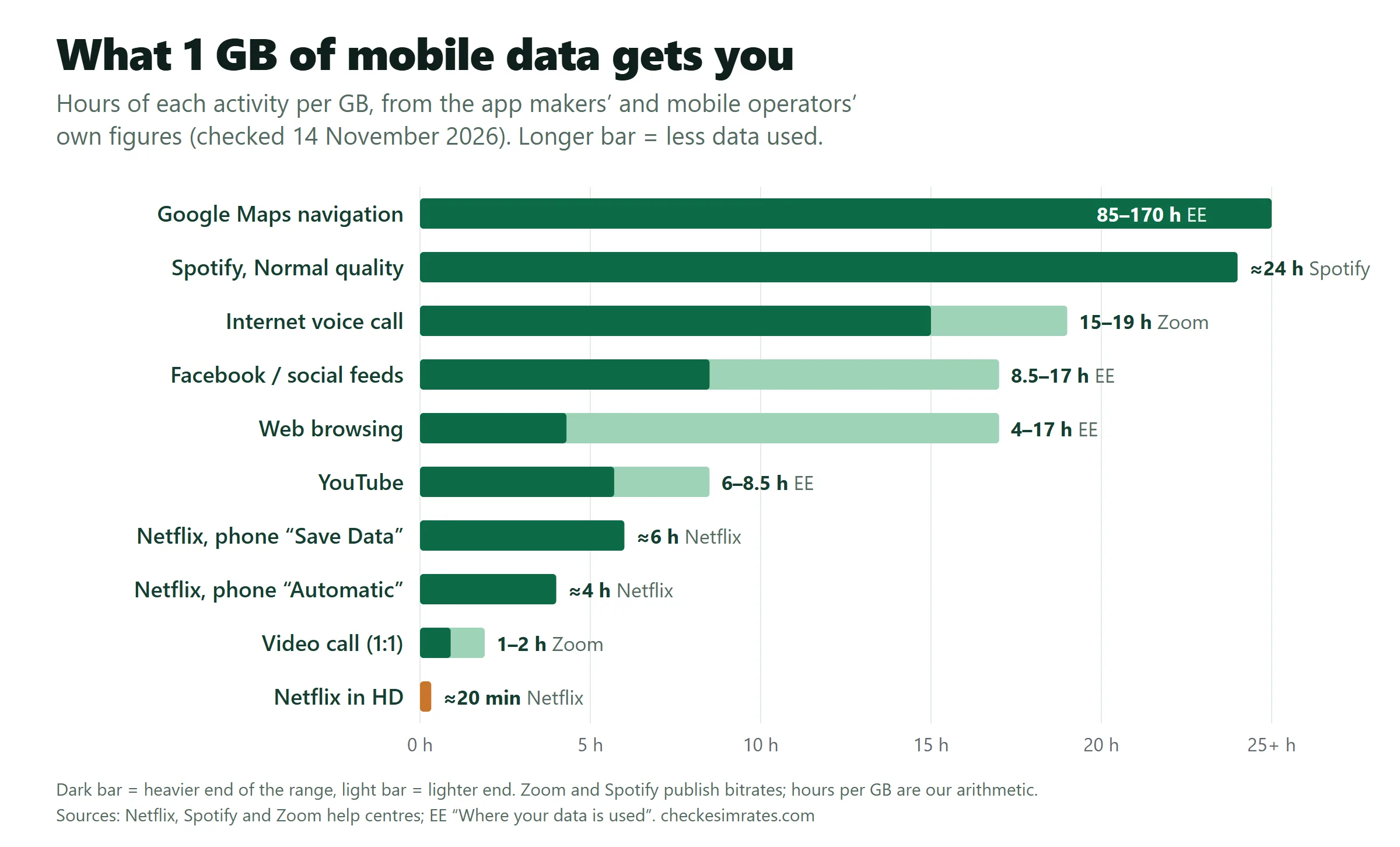
- 1 GB lasts about 85–170 hours of Google Maps navigation, but only about 20 minutes of Netflix in HD.
- A week with 7 GB costs a median $16.00 in Japan, $13.90 in France and $10.95 in Thailand (each provider’s cheapest plan, single-country eSIMs).
- Unlimited is rarely cheaper than 1 GB a day: for a week, it beat a 7 GB plan in only 3 of 127 destinations, but it matched or beat a 14 GB plan in 78.
- 51% of unlimited eSIM plans slow down after a daily allowance, and 7,337 of them after 1 GB a day or less.
How much mobile data do you use per day when travelling?
Most travellers fall into one of three groups. Pick the one that sounds like you, then multiply by the number of days you will be away from reliable Wi-Fi.
| Traveller | What you do on mobile data | Per day | 1 week | 2 weeks |
|---|---|---|---|---|
| Light | Maps, WhatsApp messages, email, checking opening hours, a few photo uploads | 0.3–0.5 GB | 3–5 GB | 5–7 GB |
| Typical | All of the above, plus an hour or two of social media, music streaming and a short call home | about 1 GB | 7–10 GB | 14–15 GB |
| Heavy | Video on Instagram, TikTok or YouTube, daily video calls, hotspot for a laptop | 2 GB or more | 15–20 GB or unlimited | 30 GB or unlimited |
Two numbers help you sanity-check this. The Ericsson Mobility Report puts average use at 22 GB a month per smartphone worldwide at the end of 2025, and 25 GB in North America and Western Europe. That is roughly 0.7–0.8 GB a day, and much of it happens on home Wi-Fi you won’t have on the road.
How much data do apps use per hour?
Video is the only thing that really eats travel data. Navigation, messaging and music barely register. These figures come from the app makers’ help pages, or from mobile operators where the app maker publishes none.
| Activity | Data per hour | Source |
|---|---|---|
| Google Maps navigation | 6–12 MB (100–200 KB a minute) | EE (Google publishes no figure) |
| Spotify music | about 11 MB (Low) to 144 MB (Very high) | Spotify: 24–320 kbit/s |
| Voice call over WhatsApp, Zoom or similar | about 55–70 MB | Zoom: 60–80 kbit/s each way |
| Facebook and social feeds | 60–120 MB | EE |
| Web browsing | 60–240 MB | EE |
| YouTube | 120–180 MB | EE (Google publishes no figure) |
| Netflix on a phone | about 170 MB (Save Data) to 250 MB (Automatic) | Netflix: about 6 and 4 hours per GB |
| Video call, one to one | about 540 MB (high quality) to 1.1 GB (720p) | Zoom: 600 kbit/s to 1.2 Mbit/s each way |
| Netflix in HD | up to 3 GB | Netflix |
| Uploading photos | about 1.5 MB a photo | EE |
Operators don’t agree closely. Music is 25–33 MB an hour at Three UK but 60–120 MB at EE, for example, so treat every figure as a range. YouTube, Google Maps, FaceTime and WhatsApp publish no per-hour numbers of their own.
How much data do you need for 1 week, 2 weeks or a month?
Multiply your daily budget by the days you will rely on mobile data, then round up to the next plan size. Plans come in fixed steps (1, 3, 5, 10 and 20 GB are the most common), so a 7 GB need usually means buying 10 GB.
- 1 week: 3–5 GB for light use, 10 GB for typical use, 20 GB or unlimited for heavy use.
- 2 weeks: 5–10 GB light, 15–20 GB typical, 30 GB or unlimited heavy.
- 1 month: 10–15 GB light, 30 GB typical, 50 GB or unlimited heavy. For longer stays, see what 3, 6 and 12 months of data cost.
Planning a Europe trip of two weeks? A typical traveller needs 15–20 GB; if you are visiting several countries, check whether one regional plan or separate country plans works out cheaper. From the US? Compare with your carrier first: in our Verizon TravelPass vs eSIM comparison, a week of TravelPass costs $84 per phone.

What does that much data cost on an eSIM?
We took every single-country eSIM plan valid for the whole trip, found each provider’s cheapest plan with enough data, and used the median. That is what a normal shopper pays without hunting for deals; the cheapest plans cost less.
| Destination (1 week) | Light: 3.5 GB+ | Typical: 7 GB+ | Heavy: 14 GB+ | Unlimited |
|---|---|---|---|---|
| Japan | $10.00 | $16.00 | $24.14 | $25.75 |
| United States | $11.50 | $16.70 | $22.07 | $25.08 |
| United Kingdom | $9.60 | $13.23 | $21.90 | $24.50 |
| France | $8.95 | $13.90 | $19.43 | $23.30 |
| Italy | $9.76 | $14.77 | $21.95 | $22.00 |
| Spain | $8.89 | $12.96 | $19.43 | $22.62 |
| Germany | $9.00 | $14.00 | $20.99 | $23.73 |
| Greece | $9.74 | $14.65 | $22.00 | $24.25 |
| Turkey | $9.34 | $14.23 | $20.75 | $23.20 |
| Thailand | $8.00 | $10.95 | $17.95 | $22.00 |
| Vietnam | $10.15 | $16.55 | $24.20 | $23.70 |
| South Korea | $10.95 | $16.00 | $27.55 | $26.50 |
| China | $13.90 | $19.00 | $30.90 | $26.75 |
| Mexico | $13.90 | $22.07 | $33.40 | $25.33 |
| Canada | $14.99 | $22.00 | $34.63 | $32.56 |
| United Arab Emirates | $12.38 | $20.00 | $34.00 | $28.69 |
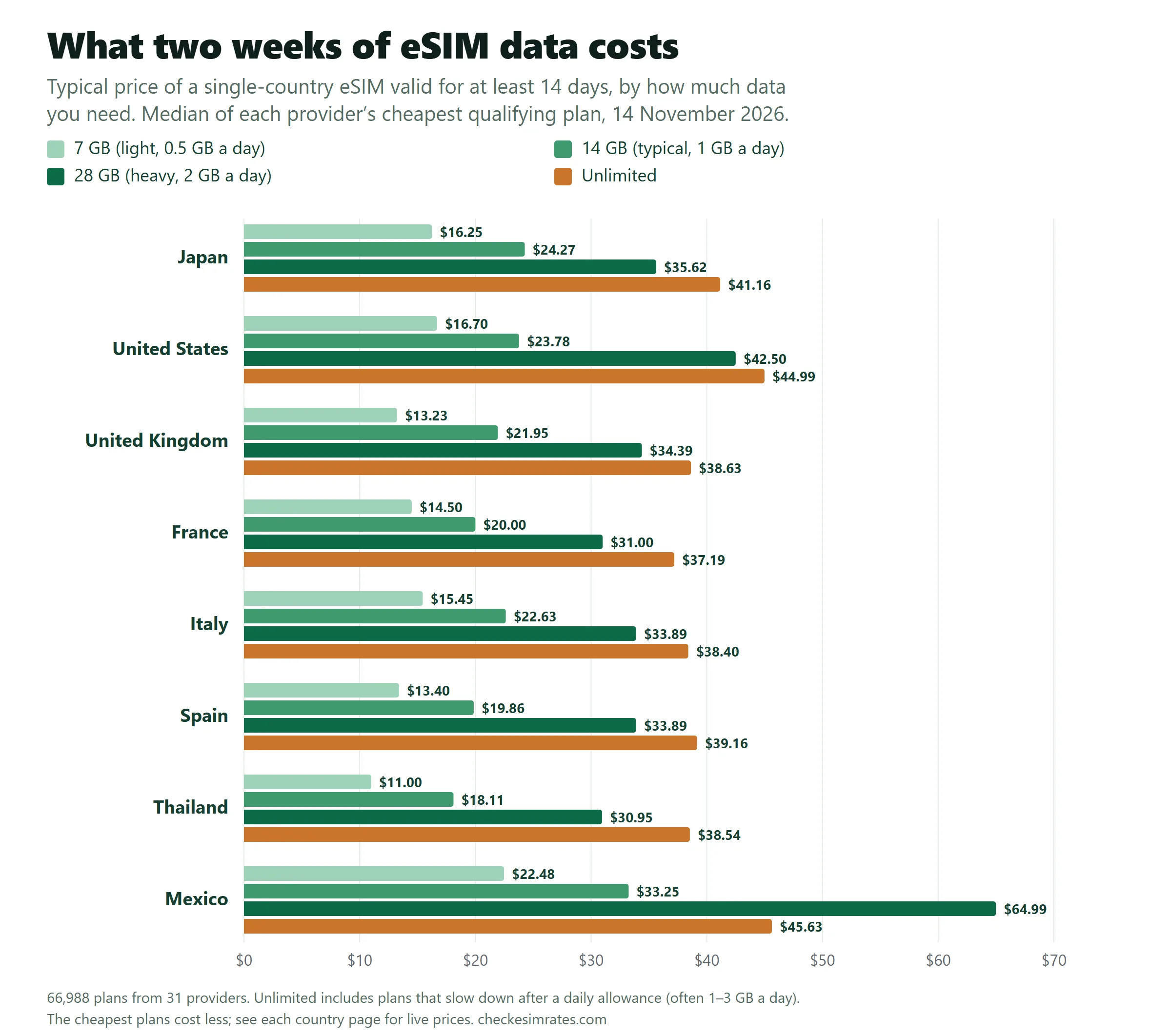
For two weeks the gap between the tiers grows. In Japan, 14 GB typically costs $24.27 and 28 GB $35.62; in France $20.00 and $31.00.
Prices per GB fall fast as plans get bigger. Across all single-country plans, the median 1 GB plan costs $5.00 per GB, a 10 GB plan $2.30 per GB and a 20 GB plan $1.66 per GB. That is why guessing low and topping up later is the expensive mistake: a small top-up costs about twice as much per GB as a 10 GB package from the same provider.
When is an unlimited eSIM worth it?
Only if you would use around 2 GB a day or more. For a week, the typical unlimited eSIM cost about the same as, or less than, a 14 GB plan in 78 of 127 destinations we could compare. But it beat a 7 GB plan in just 3. For two weeks the pattern held: unlimited matched or beat 28 GB in 54 of 100 destinations, and never beat 14 GB.
Read the small print first. In our table, 51% of unlimited plans slow down after a daily allowance, most often 1 GB a day (7,337 plans) or 2–3 GB a day. Over a week, a plan that slows down after 1 GB a day gives you at most 7 GB at full speed, so check the daily allowance before you buy. We explain the throttling rules in do unlimited eSIMs slow down? and the trade-off in fixed-data vs unlimited eSIM.
Mexico is the exception that proves the rule: a 28 GB, two-week plan there typically costs $64.99, while unlimited costs $45.63. In destinations where large plans are expensive, compare both before you buy.
How do you check how much data you use at home?
Your phone already knows your habits. Check it a week or two before you travel and divide by the days in the period.
- iPhone: Settings > Mobile Data (Cellular). The data used appears under each app; Apple’s guide to viewing cellular data use also shows how to reset the statistics.
- Android (Pixel and most phones): Settings > Network & internet > Internet, tap the gear next to your carrier, then App data usage. Google’s help page has the steps for each version.
Look at mobile data only, not Wi-Fi, and remember that on holiday you may spend more time on maps and less on your sofa’s Wi-Fi.
How can you use less data abroad?
- Turn on Low Data Mode or Data Saver. On iPhone, Low Data Mode pauses background updates, iCloud backups and video autoplay. On Android, Data Saver lets most apps use background data only on Wi-Fi.
- Download maps, playlists and shows on Wi-Fi. Offline Google Maps work for driving but not for transit or walking directions; our Google Maps abroad guide has the details.
- Lower video quality. Netflix’s Save Data setting gives about 6 hours per GB instead of 4.
- Turn off automatic photo backup to Google Photos or iCloud until you are back on Wi-Fi.
- Watch your hotspot. A laptop on your phone’s connection downloads updates at full speed; see which eSIMs allow tethering.
What happens if you run out of data?
With a fixed-data plan, the eSIM simply stops working when the data is used up, unless you add more. Most providers let you buy a top-up in their app, but you need Wi-Fi or some data left to do it. Check before you leave whether your provider allows top-ups on the same eSIM, and buy one size up if you are unsure: going from 5 GB to 10 GB typically costs a few dollars, while a 1 GB emergency top-up costs about twice as much per GB.
To compare plans for your trip, open your destination, for example Japan, Italy or the United States, and filter by data and days. Our guide on how to choose an eSIM for international travel covers the other things to check.
How we worked out these numbers
Data-use figures come from the help pages of Netflix, Spotify and Zoom, and from the mobile operator EE where the app maker publishes none, all read on 14 November 2026. Where a source gives a bitrate, we converted it to MB per hour ourselves. Averages come from the Ericsson Mobility Report (June 2026) and Ofcom’s Communications Market Report 2026. The light, typical and heavy budgets are our own rounding of these figures, not measurements of a real trip.
Prices come from the plan table CheckeSIMRates collects every night from 31 providers, as of 14 November 2026 05:44 UTC (66,988 plans). For each destination we used single-country plans valid for at least the length of the trip, took each provider’s cheapest plan with enough data, and report the median across providers. Promotional prices are included as listed. Unlimited plans include those that slow down after a daily allowance; Global YO’s 1 GB-a-day limit is stated only in its FAQ, so it is not counted in the 51%.
Travel data questions
Is 1 GB a day enough for travel?
Yes, for most travellers. 1 GB covers maps, messaging, browsing, an hour or two of social media and some music. It is not enough if you stream video on mobile data or make daily video calls, which can use 0.5–1 GB an hour.
Is 5 GB enough for a week?
For light use, yes: 5 GB is about 0.7 GB a day. If you use social media heavily or watch videos away from Wi-Fi, buy 10 GB; for a week it typically costs only $3–$6 more than 5 GB.
How much data do I need for 2 weeks in Europe?
About 15–20 GB for typical use, 7–10 GB if you mostly use maps and messaging, and unlimited if you stream. A 14 GB plan valid for two weeks typically costs $19–$23 in France, Italy, Spain or the UK.
How much data do I need for 2 weeks in Japan?
The same rule applies: about 14–15 GB for typical use. In Japan that typically costs $24.27 on a single-country eSIM, against $41.16 for unlimited.
How much data does Google Maps use?
Very little: about 6–12 MB an hour of navigation according to the operator EE, so 1 GB lasts days of driving. Downloading an offline map on Wi-Fi before you go saves even that.
Does using my phone as a hotspot use more data?
Yes. A laptop or tablet on your hotspot loads full websites, runs updates and syncs files, so it can use several GB a day. Check that your eSIM allows tethering and switch off automatic updates on the laptop.