

By CheckeSIMRates · Rental prices and eSIM plans checked 16 November 2026
eSIM vs pocket WiFi comes down to how many people share it. For one or two travellers, a travel eSIM is cheaper: a week of unlimited data in Japan typically costs $25.74 per person, against about $50–$87 for an unlimited pocket WiFi. From three people sharing, pocket WiFi wins on price, and in South Korea a KT rental router is cheaper even for one.
We read the prices on four Japanese rental companies’ and KT’s own websites and compared them with 66,964 travel eSIM plans from 31 providers. Below: what each option costs for one to four people, the fees that rental prices leave out, and when each one makes sense.
eSIM vs pocket WiFi at a glance (November 2026)
- Solo in Japan for a week: an unlimited eSIM typically costs $25.74 and a 10 GB eSIM $16.00; an unlimited pocket WiFi costs $50.26–$86.74.
- Three people sharing: the pocket WiFi drops to about $20.78 each, less than an unlimited eSIM per person, but still more than a 10 GB eSIM each.
- South Korea is the exception: KT rents an unlimited router (up to 20 Mbps) for ₩4,400 a day, about $23.06 a week, less than a typical unlimited eSIM ($26.50).
- Losing a rented router costs ¥30,000–40,000 ($188–$250) in Japan, and late returns cost extra.
- Router batteries last about 5–20 hours by the rental companies’ own specifications, so you carry and charge a second device.
- 115 of Japan’s 263 unlimited eSIM plans slow down after a daily allowance; most rental routers in our comparison have no daily cap.
What is the difference between an eSIM and a pocket WiFi?
A travel eSIM is a digital SIM you install on your phone before you travel; it gives that one phone mobile data. A pocket WiFi is a small rented router with its own SIM: you pick it up at the airport or hotel, connect several phones and laptops to its Wi-Fi, and return it at the end of the trip.
- eSIM: nothing to carry or return, works the moment you land, one bill per person. Your phone must support eSIM and be unlocked.
- Pocket WiFi: one device for the whole group, works with any phone, tablet or laptop, often with no daily data cap. But everyone has to stay near it, and it needs charging.
How much does a pocket WiFi cost in Japan?
We read each rental company’s own price page on 16 November 2026; the networks, device limits and battery times in the table are what each company states, not our tests. Prices are in yen with our conversion at ¥159.78 to the dollar.
| Company | Data | 7 days | 14 days | Pickup and return | If you lose it |
|---|---|---|---|---|---|
| Japan Wireless | Unlimited, no throttling (SoftBank 4G); up to 8 devices, 8–10 h battery | ¥9,960 ($62.33) | ¥13,623 ($85.26) | Airport or hotel; ¥500 shipping included in the price; return in a prepaid envelope in any postbox | ¥40,000 without protection |
| Sakura Mobile | Unlimited (docomo 4G); up to 15 devices, 20 h battery | ¥9,900 ($61.96) | Not confirmed | Airport, hotel or post office; postbox or Lawson return, no postage | ¥30,000 |
| WiFi Rental Store | Unlimited (docomo, 5G-capable FS050W); up to 32 devices, 9–11 h battery | ¥8,030 ($50.26) incl. ¥1,100 postage | ¥14,960 ($93.63) incl. postage | Delivered (¥1,100 round trip) or airport pickup (+¥550); postbox return | Insurance ¥550 per rental |
| NINJA WiFi | 1 GB a day, then 128 kbps (SoftBank 4G) | ¥3,080 ($19.28) | ¥6,160 ($38.55) | Free airport counter pickup; hotel delivery ¥550 each way | ¥40,000 |
| NINJA WiFi “Infinite” | Unlimited, may slow at peak times | ¥13,860 ($86.74) | ¥27,720 ($173.48) | As above | ¥40,000 |
How much does an eSIM cost in Japan?
Across 543 single-country Japan plans from 29 providers, the typical price (the median of each provider’s cheapest qualifying plan) on 16 November 2026 was:
- 1 week: 10 GB $16.00, 20 GB $24.81, unlimited $25.74 (cheapest unlimited $11.21, with 1 GB a day at full speed).
- 2 weeks: 10 GB $16.50, 20 GB $24.82, unlimited $41.16.
“Unlimited” on an eSIM often isn’t unlimited at full speed: 115 of the 263 unlimited Japan plans slow down after a daily allowance. Most travellers need 0.5–1 GB a day, so 10–20 GB usually covers a week or two; our guide to how much data you need for travel helps you check. Live prices are on our Japan eSIM comparison.
Which is cheaper for 1, 2, 3 or 4 people?
Split a week of unlimited pocket WiFi from Japan Wireless (¥9,960, $62.33) between the group and compare it with one eSIM per person:
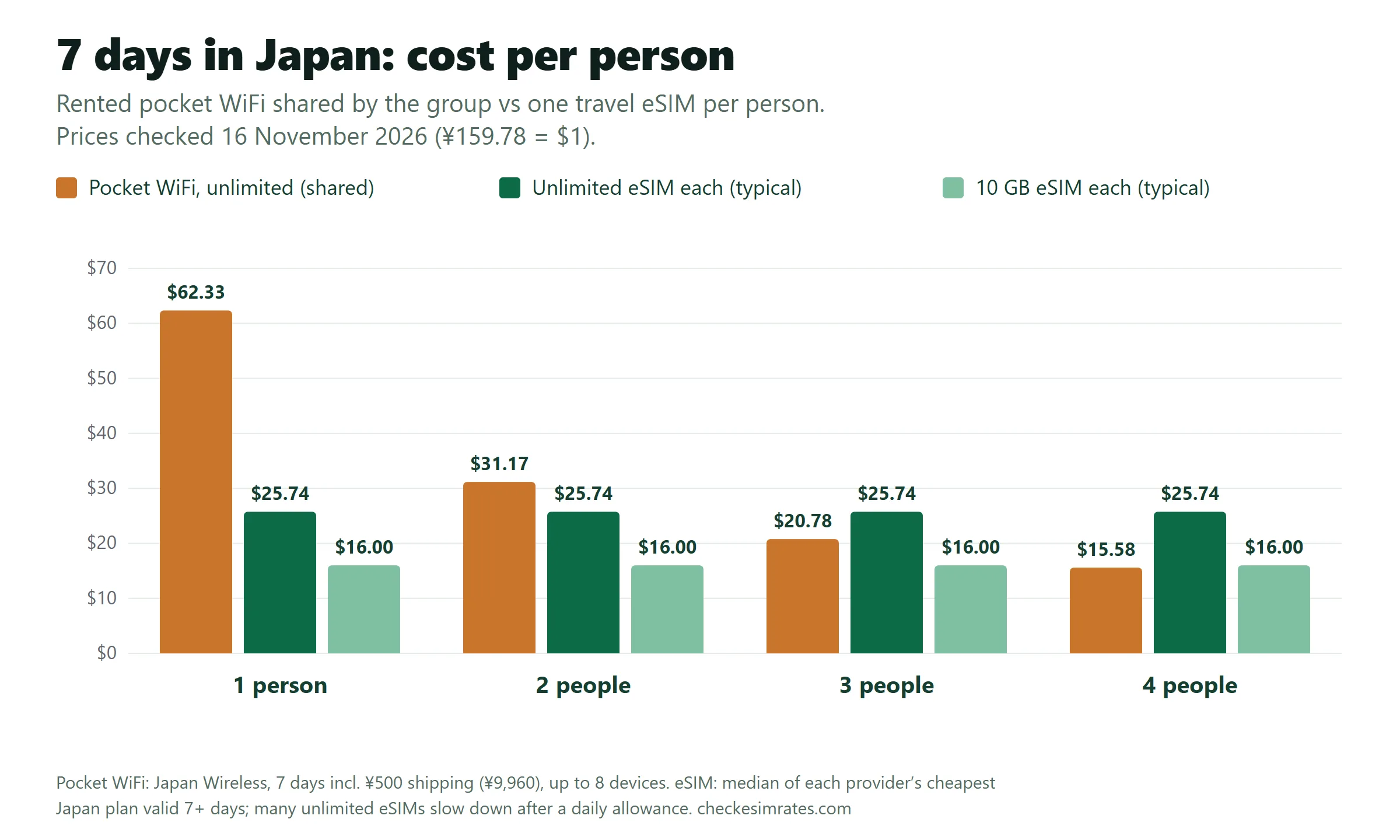
- 1 person: eSIM, clearly. Unlimited is $25.74 against $62.33 for the router.
- 2 people: still eSIM. The router works out at $31.17 each.
- 3 people: pocket WiFi, if you want unlimited data: $20.78 each against $25.74. A 10 GB eSIM each ($16.00) is still cheaper for light users.
- 4 people: pocket WiFi, $15.58 each, about the same as a 10 GB eSIM per person.
There is a middle way: one person buys an eSIM that allows tethering and shares it as a hotspot. In Japan, the unlimited plans that list hotspot use typically cost $23.52 for a week. That drains the phone’s battery, and a daily allowance is shared by everyone. See which eSIMs allow hotspot use before you rely on it.
Is pocket WiFi cheaper in South Korea?
Yes, often. According to its tourist router page, the Korean operator KT rents an unlimited router at up to 20 Mbps for ₩4,400 a day including VAT, from counters at Incheon, Gimpo and Gimhae airports.
- 1 week: ₩30,800 ($23.06), less than a typical unlimited Korea eSIM ($26.50) even for one person, and far less per person in a group.
- 2 weeks: ₩61,600 ($46.11) at the daily rate, but KT’s 30-day rate is ₩55,000 ($41.17), so take that instead. A typical unlimited eSIM costs $47.43.
- The catches: you need a credit card in your own name for the deposit (debit and Korean cards aren’t accepted), you collect and return it at the airport, and KT says speeds are capped at 20 Mbps.
A 10 GB South Korea eSIM typically costs $16.90 for a week, so a light user travelling alone still pays less with an eSIM.

What about Taiwan, Hong Kong, Vietnam and Thailand?
We could not confirm current tourist rental prices for these on the rental companies’ own websites, so we don’t quote them. The eSIM side looks like this (typical prices, 16 November 2026):
| Destination | 10 GB, 1 week | Unlimited, 1 week | Unlimited, 2 weeks |
|---|---|---|---|
| Taiwan | $18.95 | $25.13 | $41.16 |
| Hong Kong | $16.00 | $25.62 | $45.00 |
| Vietnam | $16.66 | $23.70 | $41.16 |
| Thailand | $10.95 | $22.00 | $38.52 |
Use the same test as in Japan: divide the rental’s total price, including delivery and any deposit you might lose, by the number of people, and compare it with one eSIM each.
What are the hidden costs of a pocket WiFi?
- Delivery and return: ¥500–1,100 in Japan, or ¥550 each way for hotel delivery at NINJA WiFi.
- Loss or damage: ¥30,000–40,000 ($188–$250) at the Japanese companies above; optional cover costs ¥550 per rental (WiFi Rental Store) or ¥220–440 a day (NINJA WiFi).
- Late return: ¥880 a day at WiFi Rental Store, ¥1,617 a day for an unannounced extension at NINJA WiFi, and the full daily price at Sakura Mobile.
- Battery: the rental companies list about 5–20 hours for the routers above. A spare power bank must travel in your carry-on, as the US FAA’s battery rules explain.
- Staying together: whoever carries the router has everyone’s internet. Split up for an afternoon and the others are offline.
eSIM or pocket WiFi: which should you choose?
Choose an eSIM if you travel alone or as a couple, want data the moment you land, or don’t want to carry and return a device. Check first that your phone supports eSIM, and install it at home on Wi-Fi.
Choose a pocket WiFi if you are three or more travelling together, need to connect laptops or tablets without SIM slots, or have phones that can’t use an eSIM. In Korea, KT’s router is worth a look even for one person.
Comparing other options too? See travel eSIM vs airport SIM and, for US travellers, Verizon TravelPass vs eSIM.
How we compared
Rental prices come from the rental companies’ own websites, read on 16 November 2026: Japan Wireless and Sakura Mobile through their own price calculators, WiFi Rental Store, NINJA WiFi and KT from their price pages. We converted yen and won to dollars at the open.er-api.com rate of the same day (¥159.78 and ₩1,335.91 to $1), the source our site uses for all currencies. Optional insurance and deposits are not included in the totals. We did not rent the routers ourselves.
eSIM prices come from the plan table CheckeSIMRates collects every night from 31 providers, as of 16 November 2026 05:44 UTC (66,964 plans). Typical prices are the median of each provider’s cheapest single-country plan valid for the whole trip. Hotspot figures use plans whose providers list hotspot use; many don’t say either way.
eSIM vs pocket WiFi questions
Is an eSIM or pocket WiFi better for Japan?
For one or two people, an eSIM: a week of unlimited data typically costs $25.74 per person, against $50–$87 for an unlimited router. For three or more sharing, a pocket WiFi costs less per person if you want unlimited data.
How much is pocket WiFi in Japan per day?
From ¥440 a day for a 1 GB-a-day plan (NINJA WiFi) to about ¥1,000–2,000 a day for unlimited, as of November 2026. Shipping, insurance and late fees come on top.
Is pocket WiFi worth it in Korea?
Often yes. KT rents an unlimited router at up to 20 Mbps for ₩4,400 a day (about $23 a week), less than a typical unlimited eSIM. You pick it up and return it at the airport and need a credit card for the deposit.
Can several people share one eSIM?
Yes, if the plan allows hotspot use: one phone shares its data over Wi-Fi. It drains that phone’s battery, and a daily allowance is shared by everyone, so check the plan’s hotspot rules first.
What happens if I lose a rented pocket WiFi?
In Japan you pay a loss fee of ¥30,000–40,000 (about $188–$250) at the companies we checked, unless you bought their damage and loss cover.
Does a pocket WiFi work with any phone?
Yes. Any device with Wi-Fi can connect, including phones that don’t support eSIM or are locked to a carrier. That is the main reason to choose one when travelling alone.