
Short answer: on 15 September 2026, a gigabyte of travel eSIM data cost a median of $1.73 in the United States, $1.50 in the United Kingdom and $1.59 in Japan. But the price depends far more on the size of the plan than on the country: the median plan under 1 GB cost $13.11 per GB, while plans of 50 GB or more cost $0.91 per GB. These figures come from 25,258 fixed-data eSIM plans from 28 providers, checked daily on each provider’s own website.
Key findings
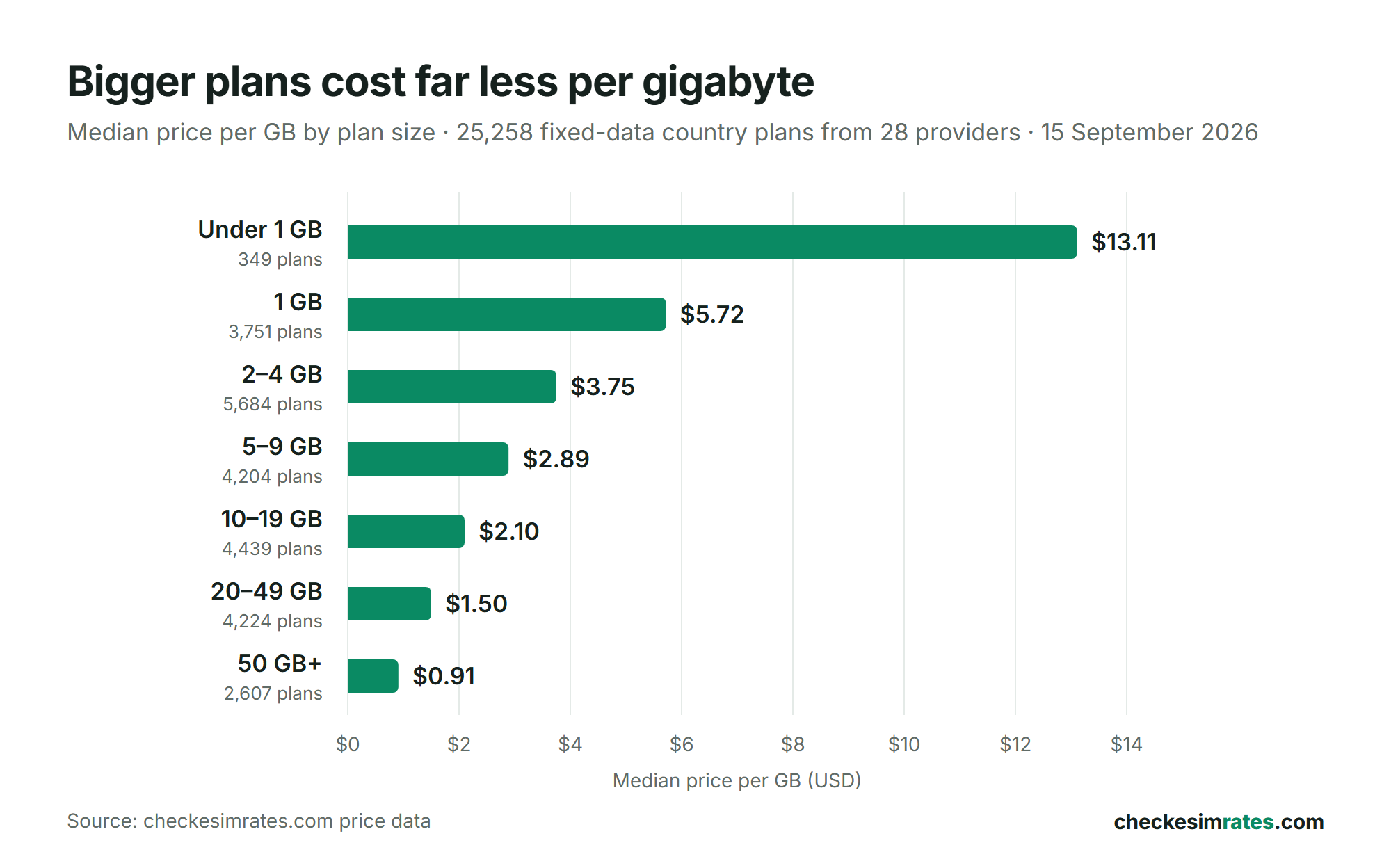
- Plan size decides the price per GB. The median price per GB falls from $13.11 for plans under 1 GB, to $5.72 for 1 GB plans, $2.89 for 5–9 GB and $0.91 for 50 GB or more (15 September 2026, 25,258 country plans).
- The same gigabyte can cost 138 times more. In the United States, 247 plans from 24 providers run from $0.13 per GB (Airhub, 300 GB for $37.99) to $17.41 per GB (eSIM2Fly, 100 MB for $1.70).
- Even ignoring the extremes, prices differ 4–6×. Leaving out the cheapest and dearest 10% of plans, the most expensive plans still cost 4.1 to 6.0 times more per GB than the cheapest in each of 10 popular destinations.
- A small plan does not have to be expensive. In all 10 destinations, at least one plan with 1–5 GB cost under $1 per GB.
Data as of 15 September 2026 · 50,828 plans from 28 providers tracked · prices in USD
How much does 1 GB of eSIM data cost?
It depends mostly on how much data you buy at once. Across 25,258 fixed-data plans for 219 destinations, the median price per GB drops at every step up in plan size. A traveller who needs very little data pays the most per gigabyte, and one who buys a large plan pays the least.
| Plan size | Plans compared | Median price per GB |
|---|---|---|
| Under 1 GB | 349 | $13.11 |
| 1 GB | 3,751 | $5.72 |
| 2–4 GB | 5,684 | $3.75 |
| 5–9 GB | 4,204 | $2.89 |
| 10–19 GB | 4,439 | $2.10 |
| 20–49 GB | 4,224 | $1.50 |
| 50 GB or more | 2,607 | $0.91 |
A bigger plan is only cheaper if you use the data. A 50 GB plan at $0.91 per GB costs about $45 in total; if you use 4 GB and the rest expires, you have paid over $11 per gigabyte you actually used.
eSIM price per GB in 10 popular destinations
The typical price is similar across popular destinations — a median of $1.37 to $1.75 per GB — but the range inside each one is wide. The “middle 80%” column leaves out the cheapest and most expensive 10% of plans, which are often unusual products such as 100 MB day passes or 500 GB plans.

| Destination | Plans | Cheapest per GB | Middle 80% of plans | Median | Most expensive |
|---|---|---|---|---|---|
| United States | 247 | $0.13 | $0.84–$3.86 | $1.73 | $17.41 |
| United Kingdom | 226 | $0.13 | $0.57–$3.46 | $1.50 | $17.41 |
| France | 214 | $0.12 | $0.59–$3.05 | $1.37 | $17.41 |
| Italy | 212 | $0.21 | $0.68–$3.17 | $1.50 | $6.87 |
| Germany | 211 | $0.21 | $0.66–$3.25 | $1.40 | $10.34 |
| Spain | 199 | $0.21 | $0.65–$3.10 | $1.40 | $6.00 |
| Turkey | 199 | $0.23 | $0.74–$3.04 | $1.43 | $6.87 |
| Japan | 194 | $0.03 | $0.75–$3.49 | $1.59 | $17.41 |
| Switzerland | 164 | $0.07 | $0.66–$3.50 | $1.75 | $17.41 |
| Thailand | 151 | $0.02 | $0.54–$2.99 | $1.46 | $17.41 |
Across the 208 destinations with at least 20 fixed-data plans, the median destination has a 4.1× gap between its 10th and 90th percentile price per GB.
The cheapest small plan (1–5 GB) in each destination
Most travellers do not need 50 GB. These were the lowest prices per GB for plans with 1 to 5 GB on 15 September 2026. Prices change daily; each destination page shows today’s list.
| Destination | Provider and plan | Price | Per GB |
|---|---|---|---|
| Switzerland | Yatelo, 5 GB for 30 days | $3.63 | $0.73 |
| Italy | Yatelo, 5 GB for 30 days | $3.79 | $0.76 |
| Turkey | Yatelo, 5 GB for 30 days | $3.79 | $0.76 |
| Germany | Yatelo, 5 GB for 30 days | $3.93 | $0.79 |
| Spain | Yatelo, 5 GB for 30 days | $3.93 | $0.79 |
| France | Yatelo, 5 GB for 30 days | $4.46 | $0.89 |
| Thailand | Yatelo, 5 GB for 30 days | $4.46 | $0.89 |
| United States | Airhub, 4 GB for 30 days | $3.75 | $0.94 |
| United Kingdom | eSIM2Fly, 5 GB for 30 days | $4.80 | $0.96 |
| Japan | eSIM2Fly, 5 GB for 30 days | $4.80 | $0.96 |
Why do eSIM prices per GB vary so much?
Plan size is the biggest reason. In this dataset, smaller allowances have higher median prices per gigabyte. This comparison measures listed retail prices, not providers’ operating costs. A large allowance can have a low unit price while costing more than a smaller plan that meets your needs.
Brands price differently on similar networks. Many travel eSIM providers buy data from the same large mobile networks and resell it, so two plans on the same network can differ several times over in price.
Extras and validity change the price. Some plans include calls or text messages, or last 90 days instead of 30, and cost more per gigabyte because of it.
Check the sorting rule. A search result or app-store position does not establish the lowest price for your trip. Our comparison lets you compare total prices and unit prices under the published ranking rules.
How to pay less for eSIM data
- Compare the price per GB, not just the price. A $9 plan is not cheaper than a $12 plan if it has a third of the data. Every fixed-data plan on this site shows both.
- Buy the amount you will actually use. A large plan has the lowest price per GB, but unused data is wasted money. Use your own recent mobile-data usage to estimate the allowance for your trip.
- Match the plan length to your trip. A 30-day plan with a lower price per GB can still cost more in total than a 7-day plan for a one-week trip.
- Compare unlimited plans by price per day. An unlimited plan has no fixed amount of data, so it has no price per GB. Also check whether it states how much data you get at full speed — two in three unlimited plans do not.
- Check the details before you buy. Coverage, whether you can top up, and whether you need an ID check all matter, and none of them shows in a price per GB.
What this comparison does not measure
A lower price per GB is not automatically a better plan. This analysis does not measure network speed, coverage in rural areas, customer support or how easy a plan is to install. It also covers only plans for a single country; regional and worldwide plans are compared separately. For a trip through several countries, see whether one regional eSIM beats separate country plans.
How we collected the data
CheckeSIMRates collects the public plan listings of 28 travel eSIM providers from their own websites every day. The figures in this article use the collection of 15 September 2026 (06:00–06:52 UTC): 50,828 plans in total, of which 25,258 are fixed-data plans for a single country. Price per GB is the plan price divided by its data amount. Prices in other currencies were converted to US dollars at approximate exchange rates for that day. The 10th and 90th percentiles are used for the “middle 80%” ranges so that a few unusual plans do not distort them.
Frequently asked questions
What is a good price per GB for a travel eSIM?
In popular destinations, the median price was $1.37 to $1.75 per GB on 15 September 2026, so anything under about $1.50 per GB is a fair price and under $1 per GB is cheap. Very small plans (under 1 GB) almost always cost more, with a median of $13.11 per GB.
Why is a 1 GB eSIM so expensive per gigabyte?
In this dataset, small plans carry a higher median price per GB. The figures describe retail pricing; they do not measure the cost of selling or supporting a plan. The median 1 GB plan cost $5.72 per GB, compared with $0.91 per GB for plans of 50 GB or more.
Is the eSIM with the lowest price per GB always the best deal?
No. The lowest price per GB usually comes with a very large plan. If you will not use most of the data, a smaller plan with a higher price per GB can cost less in total. Compare the total price for the data you need, then the price per GB.
How often do eSIM prices change?
We aim to refresh the catalogue daily, but failed or delayed collection can leave older offers in place. The figures in this article are from 15 September 2026; each destination page shows the latest prices and when they were checked.
Where can I compare eSIM prices for my destination?
Every destination has its own page with all plans ranked by price, for example Japan, the United States or Thailand. You can also search any destination on the homepage.