

By CheckeSIMRates · 66,996 plan prices from 31 providers checked 24 November 2026, plus the latest industry surveys
eSIM statistics for 2026, in short: a typical 10 GB travel eSIM for 30 days costs $27.85, and the cheapest provider in the same country charges about half that. In Holafly’s new survey, 29% of travellers now use an eSIM as their main way to get data abroad, up from 17% a year earlier.
This page starts with our own numbers: every plan from 31 providers in 223 destinations, collected from the providers’ public websites every night. The industry figures follow, each with its source and its limits.
Key eSIM statistics for 2026
- 66,996 travel eSIM plans from 31 providers cover 223 destinations (checked 24 November 2026).
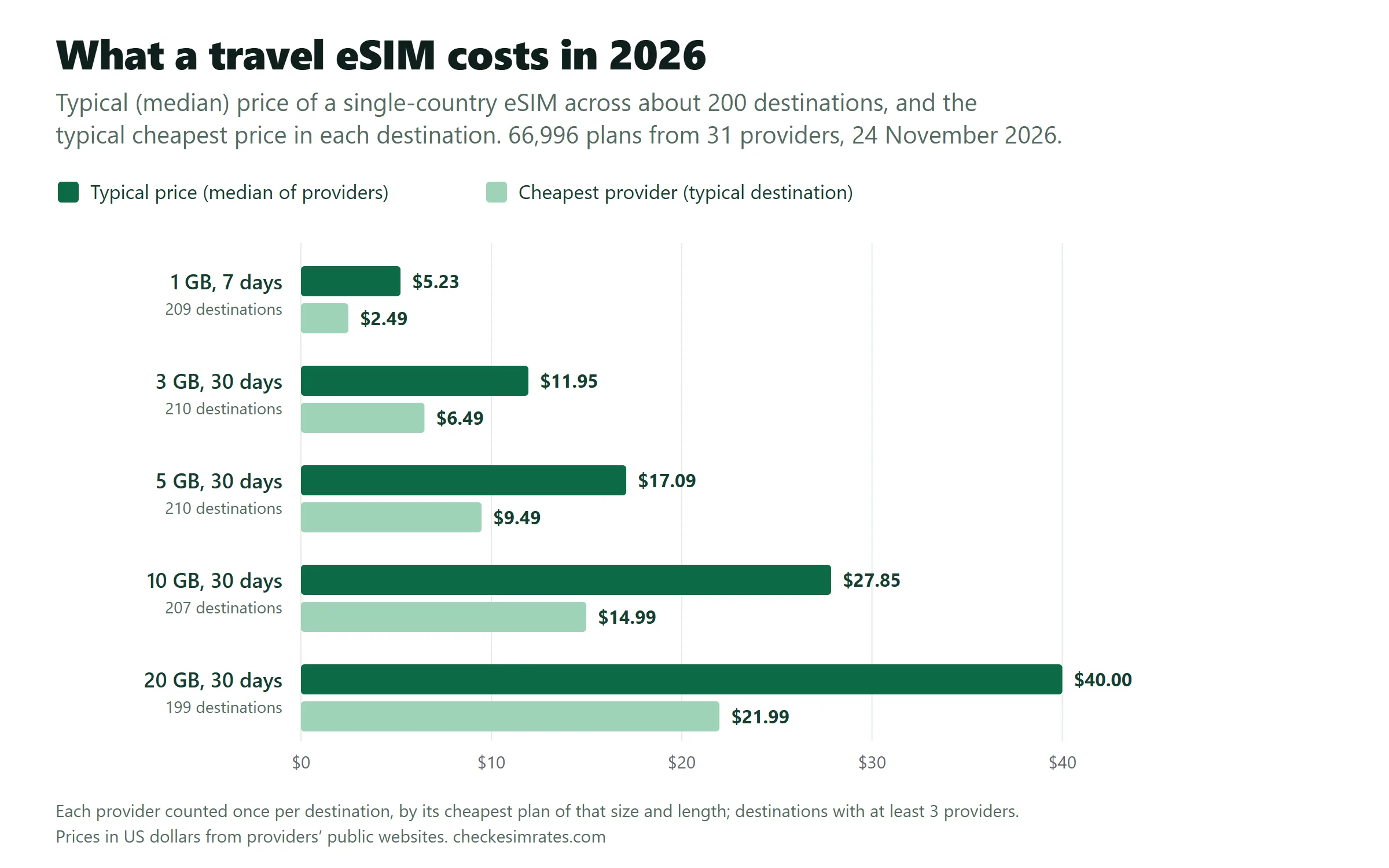
- Typical prices: 1 GB for 7 days $5.23, 5 GB for 30 days $17.09, 10 GB for 30 days $27.85, 20 GB for 30 days $40.00 (median across about 200 destinations).
- The cheapest provider in a destination typically charges about half the median: $14.99 instead of $27.85 for 10 GB.
- 1 GB of data costs a median $2.60 on single-country plans; 80% of plans fall between $0.90 and $8 per GB.
- Half of all plans are unlimited (49.7%), and only 52% of those say when the speed drops.
- Thailand is the cheapest popular destination for 10 GB, at a typical $10.97; compare Thailand eSIM prices across all 31 providers.
- 29% of travellers used an eSIM as their main way to get data abroad in 2026, up from 17% in 2025 (Holafly survey of 5,220 travellers).
How many travellers use an eSIM in 2026?
Between 12% and 29%, depending on who is counting and what they count. Survey figures from eSIM sellers sit at the top of that range, and analyst estimates of all travellers sit at the bottom.
The highest figure comes from Holafly’s Global eSIM & Travel Report 2026-2027, published 11 November 2026. Of 5,220 international travellers in 13 countries, 29% said an eSIM was their main way to get mobile data abroad, up from 17% in 2025. The share relying on local Wi-Fi fell from 25% to 16%.
Holafly’s summer report in July put “global eSIM adoption” at 28.1% for summer 2026, against 19.0% of travellers who used one in 2025. The same report calls its regional figures intended adoption, so read 28.1% as plans for the summer, not measured use. Holafly sells travel eSIMs and is one of the 31 providers we compare, and neither report gives its survey method beyond the sample size.
The analyst firm Kaleido Intelligence puts traveller adoption of travel eSIM packages at 12% in 2025 and expects 31% by 2030. The gap with Holafly is mostly about the base: Kaleido counts all international travellers, while a seller’s online survey reaches people who already know what an eSIM is.
How many phones and devices have an eSIM?
Many new phones support eSIM, but only a small share of phone connections use one. GSMA Intelligence, the research arm of the mobile operators’ trade body, says on its eSIM topic page that 5% of smartphone connections were eSIM at the end of 2025. It forecasts 4.9 billion eSIM smartphone connections by 2030, a 42% share of all SIM technologies.
ABI Research expects 660 million eSIM devices to ship in 2026, rising to 1.1 billion by 2031, according to its eSIM device shipments chart. That number includes watches, cars and other connected machines, not just phones.
How much does a travel eSIM cost in 2026?
A typical single-country travel eSIM costs $5.23 for 1 GB over 7 days, $17.09 for 5 GB over 30 days and $27.85 for 10 GB over 30 days. These are medians of what the providers in each destination charge, across about 200 destinations, on 24 November 2026.
Shopping around halves the bill. The cheapest provider in a typical destination charged $2.49 for 1 GB, $9.49 for 5 GB and $14.99 for 10 GB. For a trip to the United States, compare all 22 providers' 10 GB prices before you pick one.
| Plan | Typical price | Cheapest (typical destination) |
|---|---|---|
| 1 GB, 7 days | $5.23 | $2.49 |
| 3 GB, 30 days | $11.95 | $6.49 |
| 5 GB, 30 days | $17.09 | $9.49 |
| 10 GB, 30 days | $27.85 | $14.99 |
| 20 GB, 30 days | $40.00 | $21.99 |
How much does 1 GB of eSIM data cost?
A median $2.60 per GB on single-country plans, but the range is wide: 80% of plans cost between $0.90 and $8 per GB. Plan size explains most of it, because small plans cost far more per gigabyte.
| Plan size | Median price per GB |
|---|---|
| 1 GB | $5.25 |
| 3 GB | $3.50 |
| 5 GB | $2.98 |
| 10 GB | $2.30 |
| 20 GB | $1.66 |
| 50 GB | $1.06 |
A 10 GB plan costs less than half as much per gigabyte as a 1 GB plan. If you are unsure how much you need, our guide to how much data you need for a trip estimates it by app and trip length. We break the per-GB numbers down further in our eSIM price per GB study.
Which destinations are cheapest and most expensive for eSIM data?
For 10 GB over 30 days, Thailand, Austria and Poland are the cheapest destinations, at a typical $11, followed by San Marino, Portugal and Bulgaria at about $12. The most expensive are small or isolated markets: Cuba at a typical $167, French Polynesia $137, Mauritania $127 and Greenland $101.
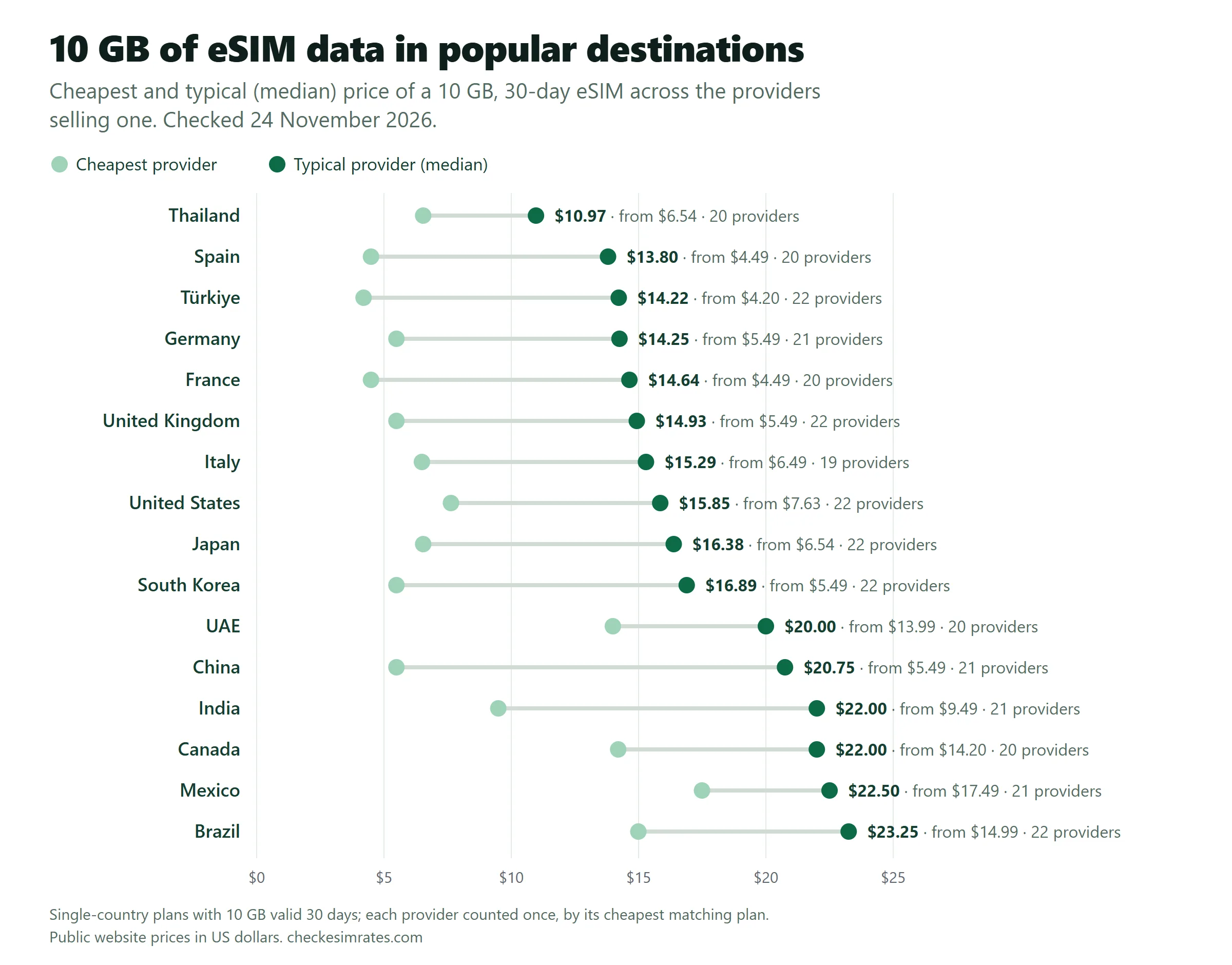
Across 16 popular destinations, prices for the same 10 GB differ by a factor of two. Japan, the United States and South Korea sit in the middle; Mexico, Brazil, Canada and India cost the most. You can see each country’s full list on its page, such as our Japan eSIM price comparison.
| Destination | Cheapest | Typical |
|---|---|---|
| Thailand | $6.54 | $10.97 |
| Spain | $4.49 | $13.80 |
| Türkiye | $4.20 | $14.22 |
| France | $4.49 | $14.64 |
| United Kingdom | $5.49 | $14.93 |
| Italy | $6.49 | $15.29 |
| United States | $7.63 | $15.85 |
| Japan | $6.54 | $16.38 |
| South Korea | $5.49 | $16.89 |
| China | $5.49 | $20.75 |
| India | $9.49 | $22.00 |
| Mexico | $17.49 | $22.50 |
Cuba is the extreme case because only six of our providers sell a 10 GB Cuba plan at all, and the cheapest costs $89.99. Our eSIM for Cuba guide explains which ones work there.
How much do prices differ between eSIM providers?
For the same 10 GB over 30 days in the same country, the most expensive provider typically charges 4.2 times as much as the cheapest. The gap is similar for other plan sizes, at 3.5 to 3.9 times.
The United States shows it well: 22 providers sell a 10 GB, 30-day plan, from $7.63 to $34. A well-known brand name does not decide where a provider lands, so compare the destination, not the brand.
What does unlimited eSIM data cost per day?
A typical unlimited single-country eSIM costs $4.66 a day on a 7-day plan, $3.98 a day for 10 days, $3.39 a day for 15 days and $2.51 a day for 30 days. Longer plans are cheaper per day, as with fixed data.
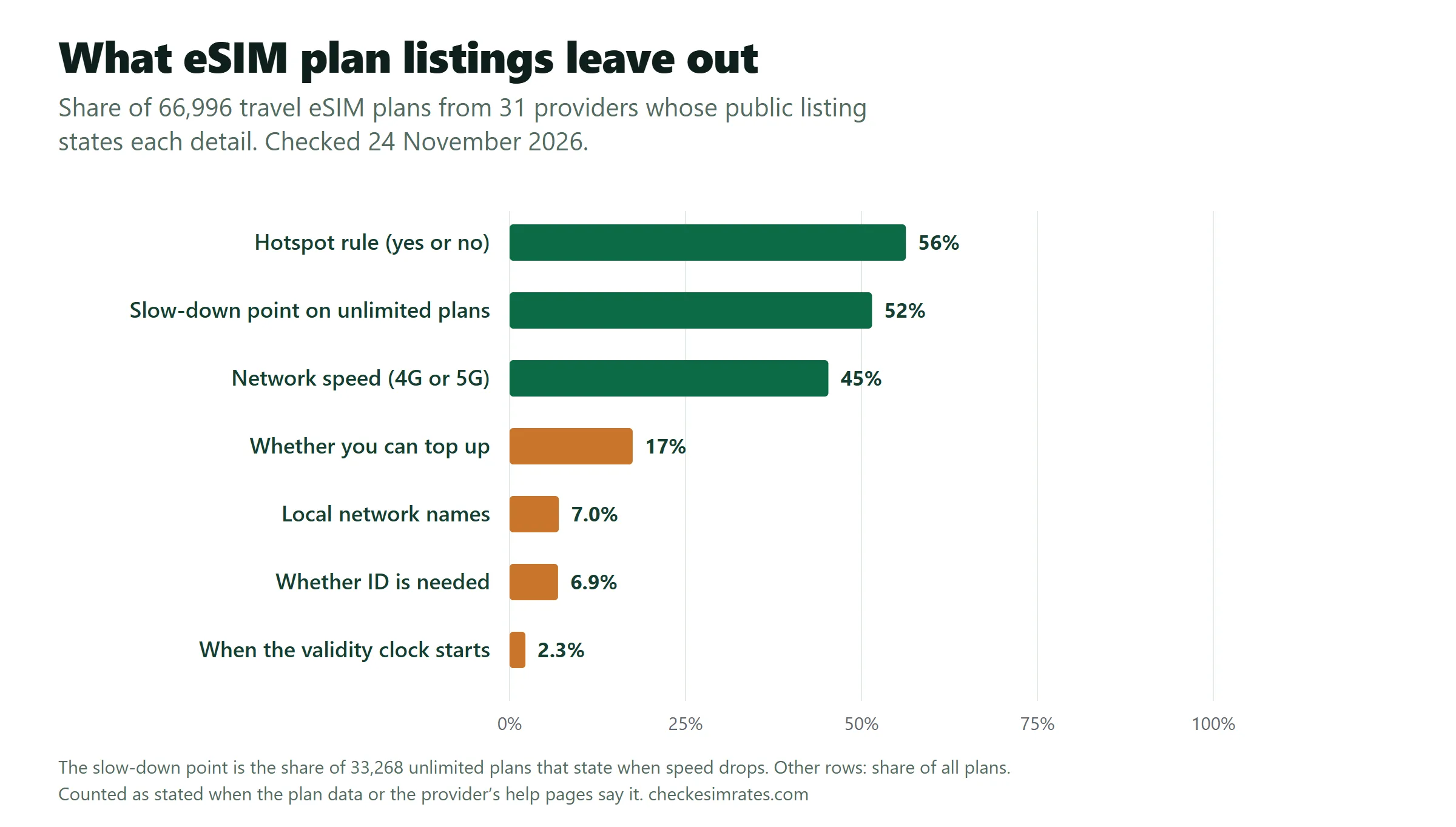
Unlimited plans make up 49.7% of the 66,996 plans, and 21 of the 31 providers sell them. Only 52% of unlimited plans say when the speed drops, Of those that do, 81% slow down after 1, 2 or 3 GB a day. Our study of how unlimited eSIMs slow down shows which providers state it.
How many eSIM providers sell each destination?
A median of 25 of the 31 providers sell a single-country plan for each destination, and 162 destinations have at least 20. Thailand is the only destination all 31 sell; Georgia, New Zealand and Türkiye have 30 each.
At the other end, 10 destinations have 3 providers or fewer. Almost all plans are single-country: 65,071 of 66,996 (97%), against 1,810 regional and 115 global plans.
The most common validity is 30 days (28% of plans), then 7 days (13%) and 15 days (11%).
What do eSIM plan listings leave out?
Most of what a traveller needs to know beyond price. Only 45% of plans state a network speed, 7% name the local network, and 2.3% say when the validity clock starts.
- 5G: 27% of plans list 5G, 18% list 4G or LTE only, and 55% say nothing about speed. Listed 5G still depends on local coverage and your phone.
- ID checks: 4,614 plans state whether ID is needed, and 96 of them require it. See which travel eSIMs ask for a passport.
- Top-ups: 11,720 plans state a top-up rule, and 10,395 of them allow one. Our eSIM top-up guide lists each provider’s rule.
- Calls and texts: 0.9% of plans include calls and 0.8% include SMS. Nearly every travel eSIM is data-only.
- Hotspot: 34,142 plans allow tethering and 3,586 do not; the rest do not say.
Do eSIM prices change often?
Rarely at the big brands. In our nightly checks from 20 to 23 November 2026, Black Friday week, 5.5% of 60,726 plans were at least 2% cheaper than their mid-October to mid-November median, and 6.3% were dearer. Holafly changed none of its 10,677 plans, and Airalo one of 1,303.
Most real discounts come as codes at checkout, which a price list does not show. Our eSIM Black Friday price analysis tracks which providers cut prices and when.
How we collected the data
Our price figures come from the plan table CheckeSIMRates builds every night from the public websites and catalogues of 31 travel eSIM providers. This snapshot was taken on 24 November 2026 at 05:43 UTC: 66,996 plans in 223 destinations, converted to US dollars at that day’s exchange rates.
Price comparisons use single-country plans. In each destination we take each provider’s cheapest plan of the stated size and length, then report the median across providers, only where at least 3 providers sell it. Feature shares count a detail as stated when the plan data or the provider’s help pages say it.
Adoption and device figures come from the sources linked in each section, read on 24 November 2026. We could not find original sources for two figures that circulate widely, a $3.3 billion travel eSIM market in 2025 and 633 million eSIM devices in 2026, so we left them out.
eSIM statistics: common questions
How many people use eSIMs when travelling?
Estimates for 2025-2026 range from 12% to 29% of international travellers. Kaleido Intelligence put travel eSIM adoption at 12% in 2025, while a Holafly survey of 5,220 travellers found 29% used an eSIM as their main data source abroad in 2026.
How much does a travel eSIM cost on average?
On 24 November 2026, a typical single-country plan cost $5.23 for 1 GB over 7 days, $17.09 for 5 GB over 30 days and $27.85 for 10 GB over 30 days. The cheapest provider in a destination typically charged about half that.
What is the average price of 1 GB of eSIM data?
A median $2.60 per GB across single-country plans from 31 providers. Small plans cost more per gigabyte: a median $5.25 for 1 GB plans against $1.66 per GB on 20 GB plans.
Which country has the cheapest eSIM data?
Among destinations with at least five providers, Thailand had the lowest typical price for 10 GB over 30 days, at $10.97, followed by Austria and Poland at $11. Cuba was the most expensive, at a typical $167.
How many eSIM providers are there?
We compare 31 providers that publish their prices online, and a typical destination is sold by 25 of them. Many smaller brands resell the same networks.
What share of smartphones use eSIM?
GSMA Intelligence says 5% of smartphone connections were eSIM at the end of 2025, and it expects eSIM to reach a 42% share of SIM technologies by 2030.
Are unlimited eSIMs common?
Yes. Unlimited plans are 49.7% of the 66,996 plans we track, sold by 21 of 31 providers, at a typical $2.51 to $4.66 a day depending on plan length. About half of them do not say when speed drops.